St. Matthew Passion

Christ Crucified (c.1632), Diego Velázquez. Museo del Prado, Madrid.

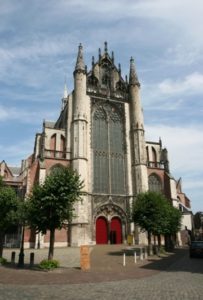
On Saturday, 25th March, Emma will sing as the alto soloist in J.S. Bach’s St. Matthew Passion, BWV 244, together with the Residentiekoor, baritone Bora Balçi, a period ensemble, and conductor Martin van der Brugge.

The St. Matthew Passion was composed in 1727. It was first performed in the St. Thomas church in Leipzig, where Bach was organist, possibly in 1727 and certainly in 1729. It was performed regularly at the St. Thomas church until the end of the eighteenth century.

Perhaps surprisingly, the St. Matthew Passion was not performed outside of Leipzig for at least a hundred years. In 1829, Felix Mendelssohn conducted a revival performance in Berlin. This revival helped introduce the works of J.S. Bach to a wider audience. In 1854, the St. Matthew Passion was performed in London. The Bach Society of London was founded five years earlier in 1849 in order to introduce Bach’s works to the public.

Today, it is inconceivable that it took over a century for Bach to become widely known and performed. Here in the Netherlands, the St. Matthew Passion has a prominent role in Passion tide. It is very probably the most-widely performed work of classical music in the country.

Performances are at 14:00 and 16:00 in the Remonstrantse Kerk, Laan van Meerdervoort 955, The Hague. These two concerts include a selection of twenty sections of the St. Matthew Passion, interlaced with story telling. It is a great opportunity for those unfamiliar with the oratorio to become acquaint anted with it.

For more information, see here.

Tickets are available here.
2017-03-20T11:47:06+02:00March 20th, 2017|

CD recording for Veterans

Recording at LAR Music

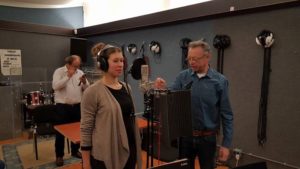
Emma was recently invited to appear as a guest soloist on the Band of Liberation’s new CD, “Days of Glory.” The repertoire includes popular and traditional songs and marches for veterans, such as ‘Danny Boy,’ ‘O Waly Waly,’ and ‘A Nightingale Sang in Berkeley Square.’ Editing will finish later this year, and the CD will be distributed to the Dutch veterans’ institute.

2017-03-20T11:29:59+02:00March 16th, 2017|

Haugtussa

On Saturday, 11th March, mezzo-soprano Emma Brown will give a short lieder recital together with pianist Isolde Troost. They will perform Grieg’s Haugtussa, op. 67 and Isolde Troost will play five of Liszt’s Consolations.

Haugtussa is a song cycle based on a poetry cycle of the same name by the nineteenth-century Norwegian poet Arne Gaborg. It is the story of a young girl who has magical powers. During the course of the song cycle, she falls in love and is rejected. Struggling to come to terms with her rejection and her magical powers, she turns to nature for consolation.

The recital is for the Friends of the Hooglandse Kerk and the Marekerk, a charity which raises funds for the maintenance of these two beautiful, historical churches in the heart of Leiden. Anyone with a genuine interest in supporting the charity is welcome.

The recital follows a short lecture, in Dutch, by Haro Schultz van Haegen, about eating and drinking in the seventeenth century as depicted in the paintings of Jan Steen, Frans van Mieris and David Bailly.

Doors open at 18:30.

For more information, in Dutch, see here. 

2017-05-20T16:39:52+02:00March 3rd, 2017|

Mozart’s Messiah

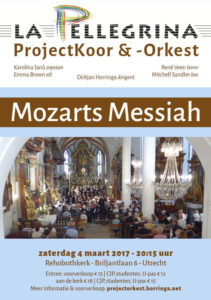
On Saturday, 4th March, Emma will sing as the alto soloist in Mozart’s arrangement of Handel’s Messiah, with conductor Dirkjan Horringa and La Pellegrina choir and orchestra. Mozart arranged Handel’s Messiah in 1789. It was intended for use in private concerts hosted by Baron van Swieten in Vienna. As well as promoting contemporary composers such as Mozart, Hadyn, and Beethoven, Baron van Swieten also (and unusually) arranged concerts of music by deceased composers such as J.S. Bach and Handel.

Mozart arranged Handel’s Messiah for a private concert hosted by van Swieten on 6th March, 1789, almost thirty years after Handel’s death. Mozart himself conducted. For more information about Mozart’s arrangement of the Messiah, click here.

The concert will take place at 20:15 in the Rehobothkerk, Briljantlaan 6, Utrecht. Tickets (€18/€15) are available at the door, and may be reserved in advance with a reduced fee (€15/€12) here.

2017-02-24T13:37:19+02:00February 20th, 2017|

Jesu Mihi Omnia – composition première

On Sunday, 19th February the Leidse Cantorij, under conductor Hans Brons, will give the first performance of Emma’s new motet, Jesu Mihi Omnia, during Evensong in the Dorpskerk in Leiderdorp, the Netherlands. The motet is also programmed for Evensong in Utrecht Cathedral on 2nd March at 19:00, and in the Hooglandse Kerk in Leiden.
The text for the motet is from the gravestone of the (allegorical) fifteenth-century esotericist, Christian Rosenkreutz.

2020-12-24T17:54:54+02:00February 13th, 2017|

Voice, clarinet, and piano ensemble

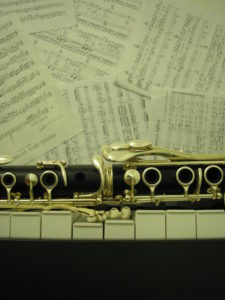
Piano and clarinet by Aruko-chan, ©2009-2017 Aruko-chan

Whereas most lieder are written for solo voice and piano, there is some repertoire for voice and ensembles – a form of chamber music, if you will. Clarinettist John Macfarlane has invited Emma to sing a programme of music for voice, clarinet, and piano, together with pianist Hein Putter. The repertoire includes an arrangement of Brahms’ Gestillte Sehnsucht and Geistliches Wiegenlied (originally composed for voice, viola, and piano), songs by Louis Spohr and Margot Wright, and Three Folksongs arranged for voice, clarinet, and piano by John McCabe.

The trio will perform on Wednesday, 25th January at 17:00 at the LUMC Boerhaaveplein and on Saturday, 4th February at the Oxford and Cambridge Society of the Netherlands’ Candlemas evening (members and their guests only).

2020-12-24T17:55:04+02:00January 16th, 2017|

Reflecting on 2016

2016 has been a wonderful year with a huge variety of experiences, including Remembrance ceremonies in Normandy and Ypres, concerts for veterans, singing in Tattoos in Northern Ireland, the Netherlands and Poland, oratorio solos, Lied recitals, and thigh-slapping as King Arthur in The Hague’s expat pantomime. It is now two and a half years since I graduated and I would like to use this moment to reflect.

One of the lessons I have learned is that the most satisfactory performances are often nicely unexpected. I first realized this one rainy day back in March, 2010. A friend called me with a rotten cold to ask if I would replace her singing ‘Ave Maria.’ It turned out that I was to sing to a terminally-ill lady in a hospital. I found it very difficult to hold back my tears, knowing that this lady was soon to die and leave her daughters behind.

That same day, I sang for the first time at the Dutch National Opera. A conductor had invited a group of conservatoire students, myself included, to sing as a chamber choir in Dallapiccola’s opera “Il Priggioniero.” I was twenty-four and singing in a world-famous opera house: a potential moment for excitement, even pride. Instead, my thoughts turned back to the seven people in the hospital.

After I graduated, I spent the best part of a year earning through singing alone. Whilst I enjoy singing, I find networking, self-promotion and auditioning tiring, expensive, and demotivating. I therefore decided to be more selective about where and what I sang. Since then, many interesting opportunities have opened to me. In particular, singing with the Band of Liberation and the West Yorkshire Police Band at remembrance ceremonies in Normandy, Ypres and the Netherlands. 

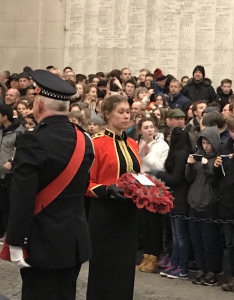
Remembrance ceremonies are humbling. As I stood preparing to sing during the Last Post ceremony at the Menin Gate on Armistice Day, I noticed the plaque on the wall: “To the armies of the British Empire who stood here from 1914 to 1918 and to those of their dead who have no known grave.” My stomach turned. I had mistakenly thought the thousands of names on the gate were of all those who died in Flanders. But the names are in fact only those who went missing in the battle of Ypres alone: a mere fraction of the total losses.

When one sings at a remembrance ceremony, a children’s hospice, or an old people’s home, it does not feel like a performance, but like an act of service. There is very little I can do to atone for the war dead or for the traumas of survivors. But I can sing, and maybe, though singing, I can show my respect to them and my gratitude for the freedom and comfort in which we live today.

And this is where I find satisfaction in my work: in singing as serving. Of course, it is thrilling when large audiences are appreciative – I will not easily forget the sound of 11,000 people clapping at cheering at the Belfast Tattoo – but the most beautiful moments are when one feels a sense of duty done.

There are already several performances planned for 2017 including remembrance ceremonies in Normandy and Flanders, military tattoos, lied recitals and oratoria.

2017-02-13T23:02:18+02:00December 30th, 2016|
Go to Top