
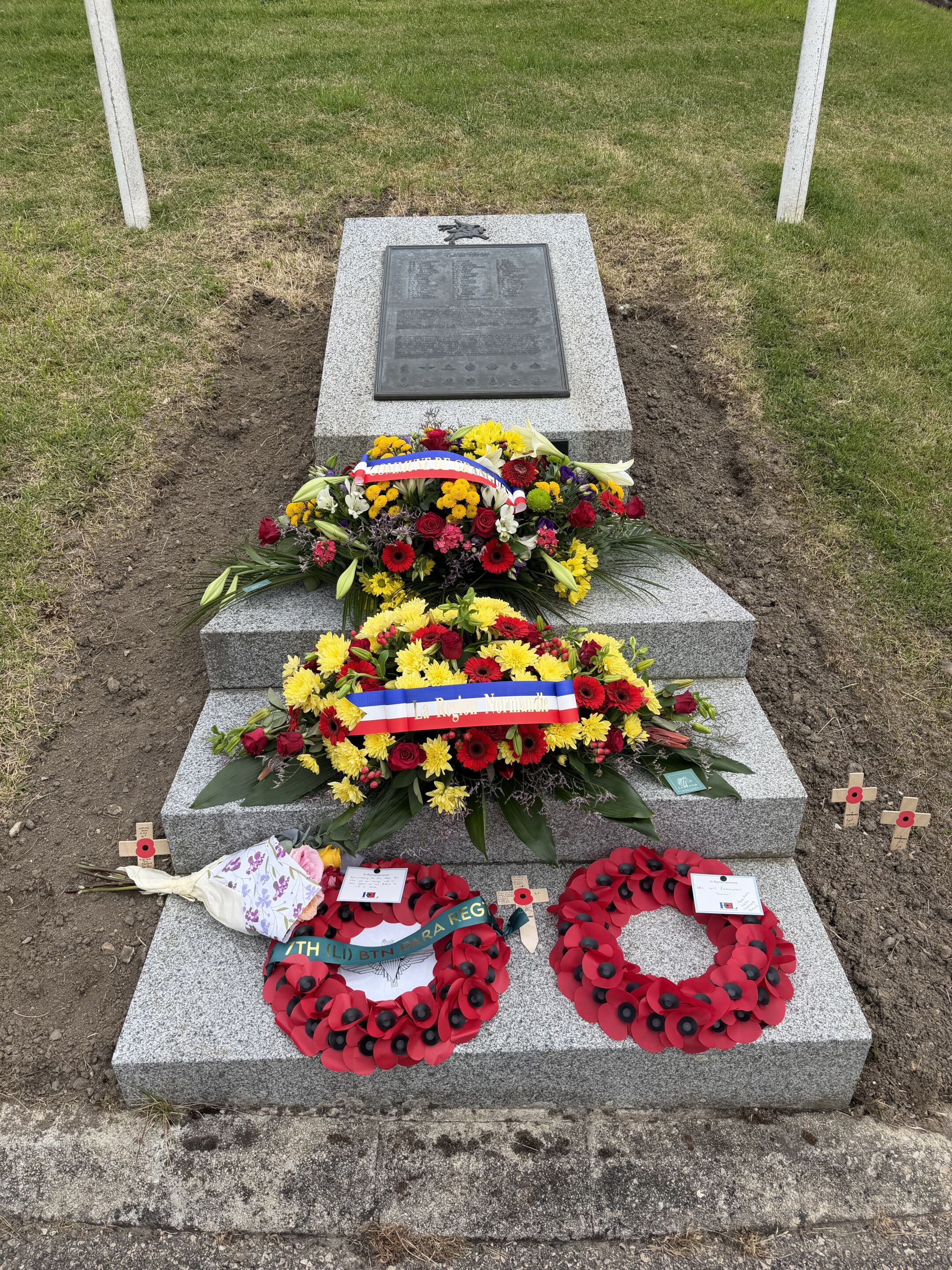
The commune of Grangues gathers each year on 7th June to commemorate four local aspects of the Battle of Normandy.
First we stood at the memorial to the British and Canadian airmen, some of whom died in crashes. Eight of the survivors were taken to the castle at Grangues and shot when they were prisoners of war. Allegedly they tried to escape, but I heard from descendants of those living in Grangues during the war that they were injured and the enemy did not wish to care for them, so they were shot at close range. I sang ‘Going Home’ and led the anthems.
We then made our way to the doors of the church to commemorate the civilians of Grangues who died in the war. The list is uncomfortably long for such a small commune, the surnames the same as members of the organisation and the graves in the church cemetery.
Third, we went to the ashes of Wally Trout, who parachuted into Grangues when his plane caught fire and hid in the valley. He was taken prisoner and sent to a camp Stalag 4B near Dresden. He survived and witnessed the liberation of the camp by the Russians.
After the war, he returned regularly to Grangues and the area, and spoke to school children about the war. His message was clear: “never again.”
One of his final requests was that his ashes should be taken to Grangues, and this request was honoured. This year, I sang ‘Danny Boy’ at his memorial.
Finally, we went to a plaque for the French Resistance fighter Léon Tardy who lived in Grangues. Before he joined the resistance, in 1940, he sheltered two Englishmen who were unable to escape from Dunkerque, disguising them as seasonal workers from Bretons to masque their lack of French. Eventually, he organised their return to England. He also saved two Americans, three Canadians, and one Norwegian. In March 1944 he was arrested and deported: he died on 1stMay 1945. His motto was “Live free or die.”